Flower Rites
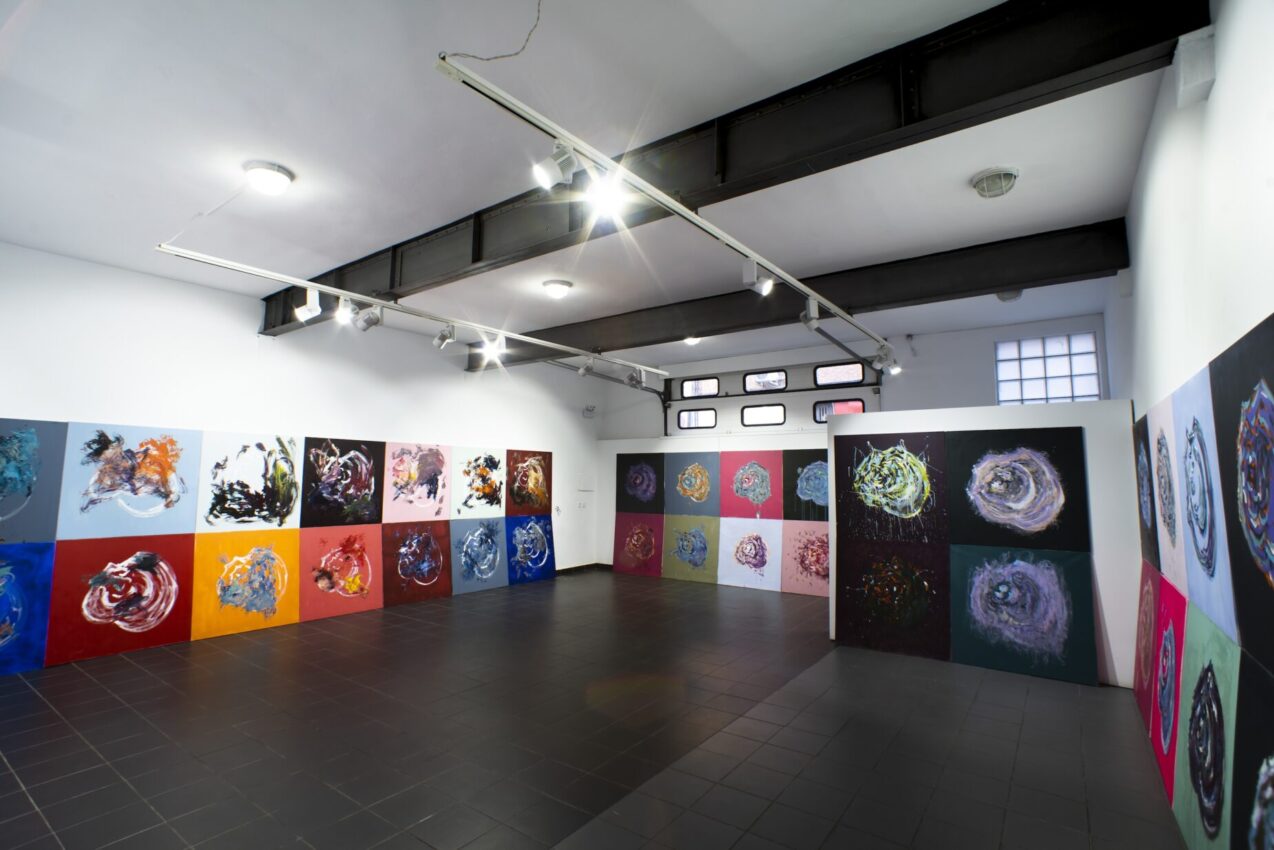
Flower Rites approaches painting as a ritualized and embodied process shaped by shifting emotional, sensory, and psychological states. The works emerge through states of focused immersion in which bodily movement, sound, material interaction, and perception converge in real time. Rather than constructing predetermined images or compositions, the series allows gestures, rhythms, and material responses to unfold intuitively through sustained concentration and sensory awareness.
The series is rooted in the idea of ritual as a temporary condition of heightened attention. Through painting, ritual operates not as symbolic reenactment, but as a method for regulating perception, grounding bodily awareness, and reconnecting with internal states often suppressed within the structures of everyday life.
Music functions as an activating force within the process, influencing rhythm, movement, and temporal perception. Working in states of near-automatic action, the paintings are frequently executed without conscious recollection of specific gestures, allowing intuition, repetition, and bodily response to guide decision-making beyond deliberate control.
The process incorporates hydrangea flowers, Japanese calligraphy brushes, and childhood crayons as perceptual instruments rather than symbolic objects. Each material alters the relationship between body and surface in distinct ways. Hydrangeas introduce fragility, instability, and organic tactility, allowing sensation to expand into color and movement. Calligraphy brushes extend bodily motion through fluid and continuous gestures, balancing discipline with improvisation. Crayons produce repetitive monotone lines that evoke tactile memory, instinctive mark-making, and altered perceptual states associated with childhood experience.
The series is also informed by the spatial understanding of ritual found in Shinto practice, where sacredness is not fixed to a permanent site but temporarily activated through action and attention. Similarly, the canvas becomes a provisional perceptual space shaped by the intensity of the painting process itself. Once the act concludes, the condition dissolves, leaving behind only material traces of a transient convergence between body, cognition, sensation, and environment.
Rather than functioning as representations of emotion or spirituality, the works operate as residual records of temporary perceptual conditions. Flower Rites treats painting as a performative event in which movement, ritual, memory, and material interaction briefly become visible before returning to impermanence.
Resilient Bloom
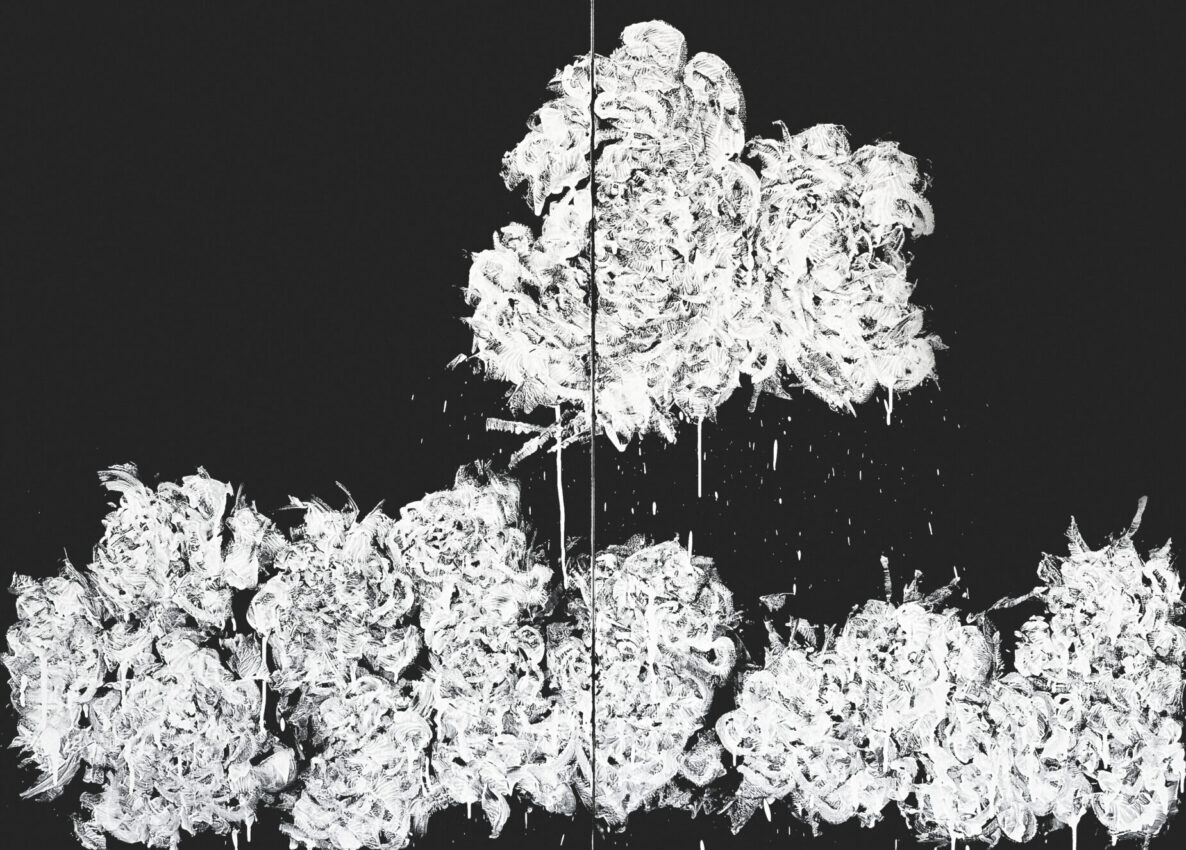
Resilient Bloom examines the instability of moral categories and the psychological tension produced by social judgment, cultural displacement, and collective systems of value. Through monochromatic floral compositions, the series investigates how concepts such as “good” and “evil” are continuously shaped, performed, and negotiated within social environments rather than existing as fixed or universal conditions.
The work emerges from Hasegawa’s long-term confrontation with moral ambiguity and experiences of social marginalization across different cultural contexts. Growing up in Japan, he developed close relationships with underground communities and individuals positioned outside normative social structures. These encounters complicated binary understandings of morality, revealing acts of care, solidarity, and vulnerability among those socially categorized as “bad,” while exposing forms of hypocrisy, violence, and exclusion within systems associated with moral correctness and social respectability.
Rather than presenting morality as a stable ethical framework, the series approaches it as a fluid and situational construct shaped by environment, perception, power, and collective behavior. This tension is further intensified through the artist’s experience of living in Spain as a Japanese individual navigating cultural translation, social projection, and persistent states of partial belonging.
Traditional Japanese tattoo culture operates as an important conceptual and visual reference within the series. Historically associated with both ornamentation and social stigma, tattooing functions here as a symbol of resistance against imposed moral hierarchies and normative systems of visibility. The chrysanthemum — a recurring motif in traditional Japanese tattooing — becomes a central perceptual structure within the work. Simultaneously delicate and resilient, the flower operates as a shifting signifier through which attraction, vulnerability, aggression, mourning, and transformation coexist without fixed resolution.
Executed primarily in black and white, the paintings reduce visual information to emphasize gesture, density, rhythm, and repetition. Through this restrained visual language, the chrysanthemum becomes increasingly abstracted, dissolving stable symbolic interpretation and instead operating as a psychological and perceptual field. The works do not attempt to provide moral conclusions, but rather expose the instability of binary systems that separate purity from corruption, belonging from exclusion, or beauty from violence.
Questions surrounding cultural ownership, appropriation, assimilation, and social integration remain intentionally unresolved throughout the series. Rather than proposing definitive answers, Resilient Bloom maintains a state of tension in which conflicting values, identities, and emotional conditions coexist simultaneously.
Within this unstable space, the chrysanthemum ultimately emerges not as a symbol of moral certainty, but as a resilient form capable of holding contradiction, ambiguity, and vulnerability at once.
Obsession
Obsession investigates repetition as both a psychological condition and an embodied process. The series emerges through the repeated painting of roses using Japanese calligraphy brushes and real roses, producing accumulative surfaces shaped by sustained attention, compulsive gesture, and ritualized movement. Through the continual return to nearly identical forms, the work examines how fixation alters perception, temporality, and sensory experience.
Rather than treating obsession solely as a subject, Hasegawa approaches it as a procedural condition embedded within the act of painting itself. The repetitive rendering of the same motif becomes a method for observing how desire, attraction, control, exhaustion, and cognitive fixation circulate through bodily action over time. Meaning does not reside in any individual image, but emerges through duration, accumulation, and the persistence of repeated gestures.
The rose functions simultaneously as image, tool, and material agent within the process. Real roses introduce instability, tactility, fragility, and organic variation into each mark, while calligraphy brushes extend bodily movement through rhythmic and disciplined repetition. Together, these tools transform painting into a performative system in which minimal variations in pressure, tempo, saturation, and movement become increasingly perceptible through repetition.
Each work explores different combinations of density, rhythm, and spatial accumulation, reflecting shifting emotional and perceptual states contained within obsessive behavior. What may initially appear monotonous or excessive gradually reveals subtle differences generated through prolonged concentration and embodied repetition. In this sense, the process itself becomes the conceptual structure of the work: obsession is not represented, but enacted.
The series also destabilizes conventional hierarchies within painting. Rather than organizing compositions around focal points or symbolic emphasis, each repeated element carries equal weight and presence within the surface. Through this flattening of visual importance, the work reflects the recursive logic of obsessive thought, where attention continuously returns to the same form without resolution.
The tension between the visual delicacy of the rose and the psychological intensity of repetition produces an unstable perceptual space in which attraction and discomfort coexist. Obsession ultimately treats repetition not as mechanical reproduction, but as a temporal and embodied condition through which cognition, desire, memory, and material process continuously interact.
Neo-Japonism
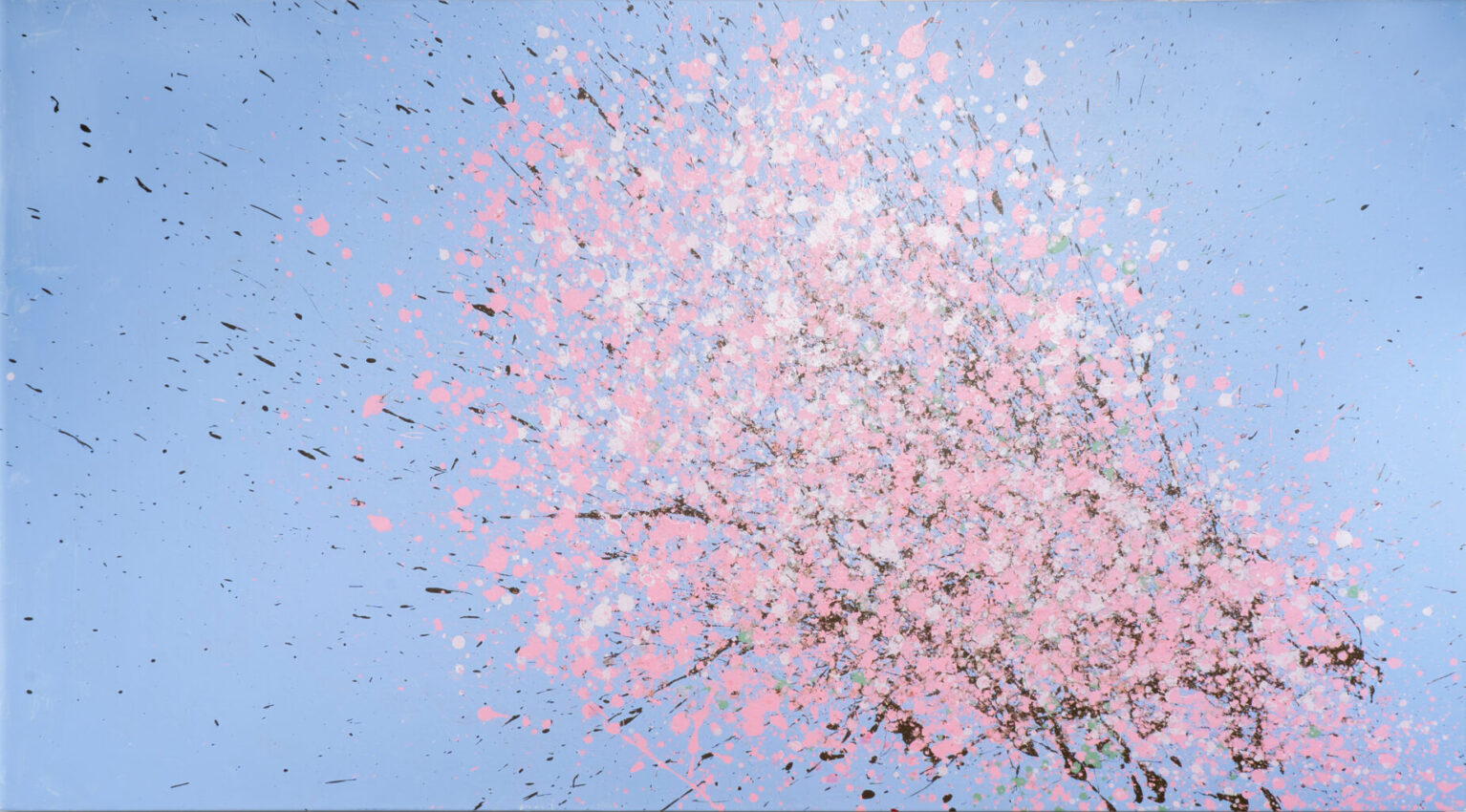
In this series, the artist aims to visualize haikus, the world's briefest form of poetry, to capture the experiences of perceiving the ephemeral beauty of flowers in spring in Japan based on personal encounters. It is a combination of Japanese poetic expression, minimalist aesthetics, and contemporary art. Neo-Japonism is a cultural advocacy that reinterprets Japanese culture in the context of globalization by Japanese artists, with the goal of proposing novel ways to present Japanese culture to the global society. Nowadays, Japanese culture has significant impacts on creations in Western countries, where numerous artists draw inspiration from Japanese culture. Through this, the artist seeks to foster a dialogue between Western and Japanese societies, challenging our perceptions of cultural appreciation and consumption.
Drawing inspiration from both 19th and early 20th-century Japonism and 21st-century contemporary art, Masaaki Hasegawa, a Japanese artist based in Spain, proposes an alternative approach to appreciate and interpret Japanese culture.
In this series, blank space takes center stage in expression, reflecting the essence of Japanese aesthetics. For instance, in works combining different colored squares in black and white flower compositions, observers are invited to complete the artwork by imagining colors in the blank areas, relying on the colors of the squares. By intentionally leaving additional information, such as specific locations or background elements, blank, an abstract expression is achieved where beauty exists not in reality but only in the viewer's mind.
Transition
Transition explores impermanence, dematerialization, and emotional transformation through the use of flowers in altered material states. The series is informed by the cultural practice of cremation in Japan, where physical dissolution operates not only as a funerary act, but also as a perceptual and psychological transition between presence, absence, memory, and acceptance.
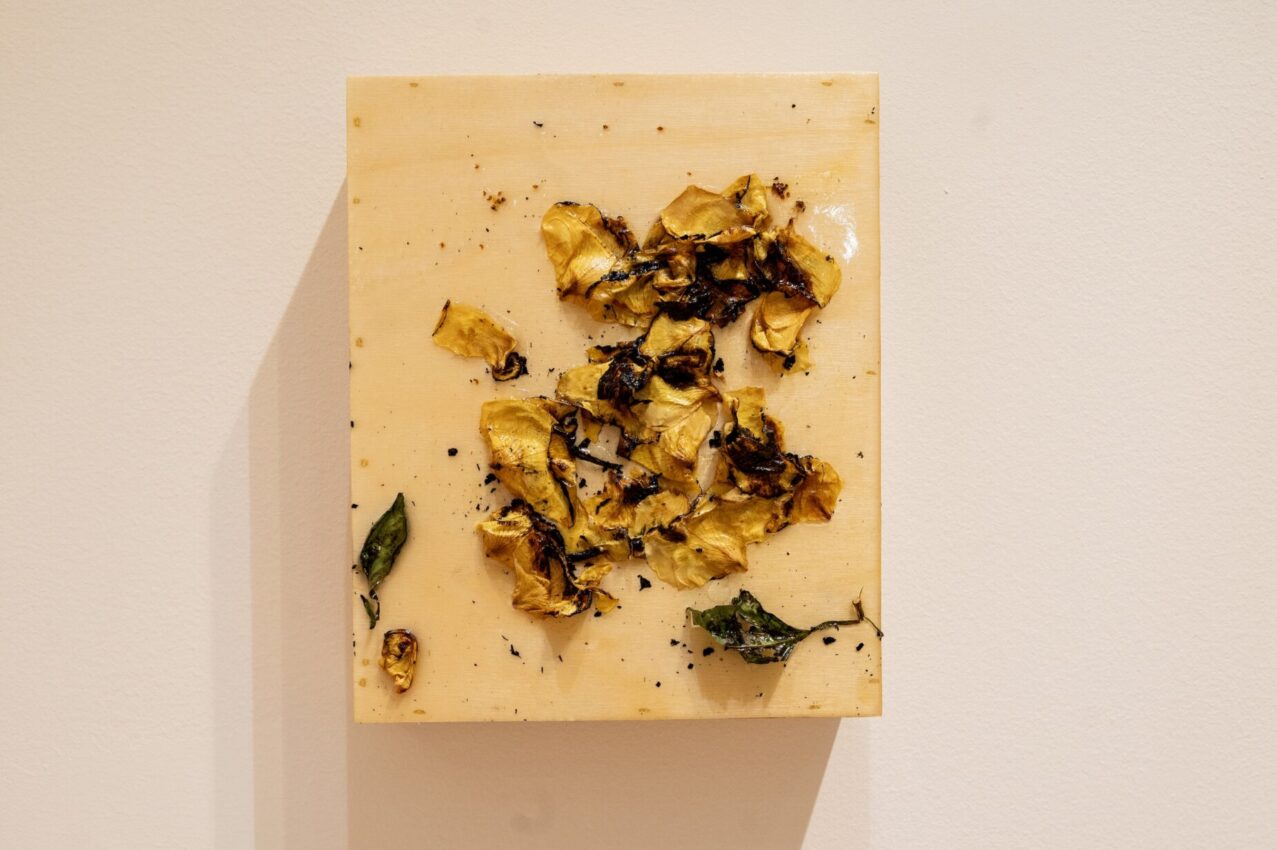
Central works within the series incorporate burned flowers preserved within abstract compositions. Through combustion, flowers traditionally associated with vitality, fragility, and ephemerality are transformed into delicate residual forms suspended between preservation and disappearance. The works examine how material destruction can simultaneously generate new forms of perception and emotional awareness. Rather than representing death directly, the burned flowers function as material traces of prior states — remnants of organic vitality and sensory beauty that can no longer be physically recovered.
Alongside these works, the series also includes paintings created with fresh flowers used as brushes in combination with Japanese paper and calligraphy ink. Unlike the preserved burned flowers, these works are executed through rapid and highly ephemeral gestures, often completed within seconds or minutes. The speed of the process becomes essential to the work itself: marks emerge and dissipate almost simultaneously, resembling ash dispersing through air or the fleeting transition between appearance and disappearance.
The use of Japanese paper and calligraphy ink further intensifies this temporal condition. Ink absorption, fluid movement, and the fragility of the paper preserve the immediacy of bodily action without allowing correction or stabilization. Flowers operate not as symbolic motifs, but as perceptual instruments that introduce instability, tactility, and organic variation into each gesture. Through these accelerated processes, the works capture transient moments in which movement, sensation, and material interaction briefly converge before dissolving.
Across the series, Hasegawa investigates the instability of aesthetic experience itself. Viewers may initially approach the works through attraction toward the delicacy and beauty associated with flowers, only to encounter materials transformed into unfamiliar, fragile, or disappearing states. This perceptual shift produces a tension between beauty and absence, preservation and dissolution, material presence and psychological emptiness.
By preserving burned organic matter beneath layers of resin while simultaneously producing rapidly executed ink works that resist permanence, Transition oscillates between fixation and disappearance. The series does not treat impermanence as a symbolic theme, but as a structural condition underlying material existence, emotional experience, bodily perception, and memory itself.
A-B-S-T-R-A-C-T
This series visualizes human emotions that are not readily captured by words. It challenges the linguistic perception of one’s self and is an attempt to label the phenomena of the human mind.
Through the creation process, it tries to reduce the amount of “conscious intensity” the human attempt to make something perfect in order to extract unconsciousness, which can handle far more information and enables access to the essence of human experiences.
Seeing humanity as a small part of the universe that partially experiences universal phenomena, the creation process tries to incorporate the essence of nature/universe in an attempt to convert inorganic materials into organic being.
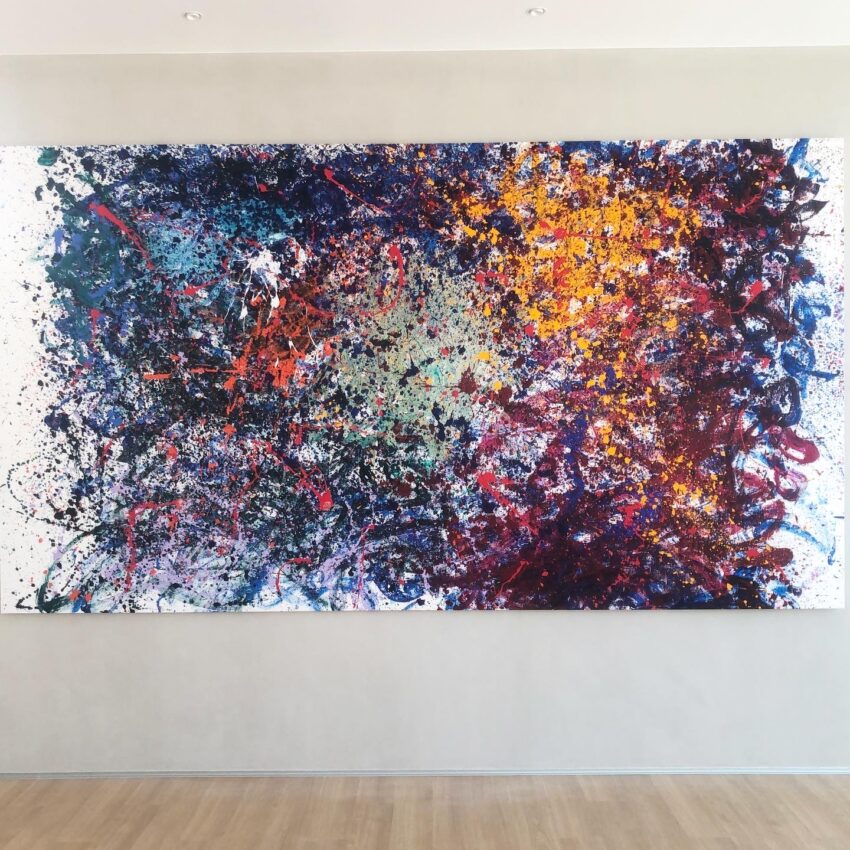
Sound Of Colors-colors dance and make the sound of music. When you are hearing the sound of colors, you don’t need to think of the composition because they tell you where they would like to be. The music exists because we dance. Art exists because we create. Colors exist not in objects but in your mind. This is the end of art theory and the beginning of human being. Art exists for us. It’s not that we exist for art and it’s theories. Everything starts with the perception and so we need to feel first.
Metamorphosis
Masaaki's work attempts to resolve the profound gap between the understanding of feelings and their logical, verbal explanation. The artist's personal life combined with his powerful sensitivity makes him capable of translating his synaesthetic experiences into paintings of an expressionist character. His gesture, at the same time fleeting and forceful, together with his knowledge of various languages, allows him to express in a fluid way his main concerns about life, human relationships, his feelings in contrast with the context he chooses and inhabits.
On this occasion, with his series "metamorphosis" he takes a logical step in which he intends to transfer in a more evident way the capacity given to the spectator to close the meaning of the work, assuming that without the work that corresponds to the spectator to feel through his observation the work would never be complete.
Masaaki proposes again, this time using a Japanese calligraphy brush and only the combination of three colors: black, white, and red, a game of perception that invites the spectator to "fill" the emptiness with his experience of what he has lived. A dance to which the word, once again, arrives late...
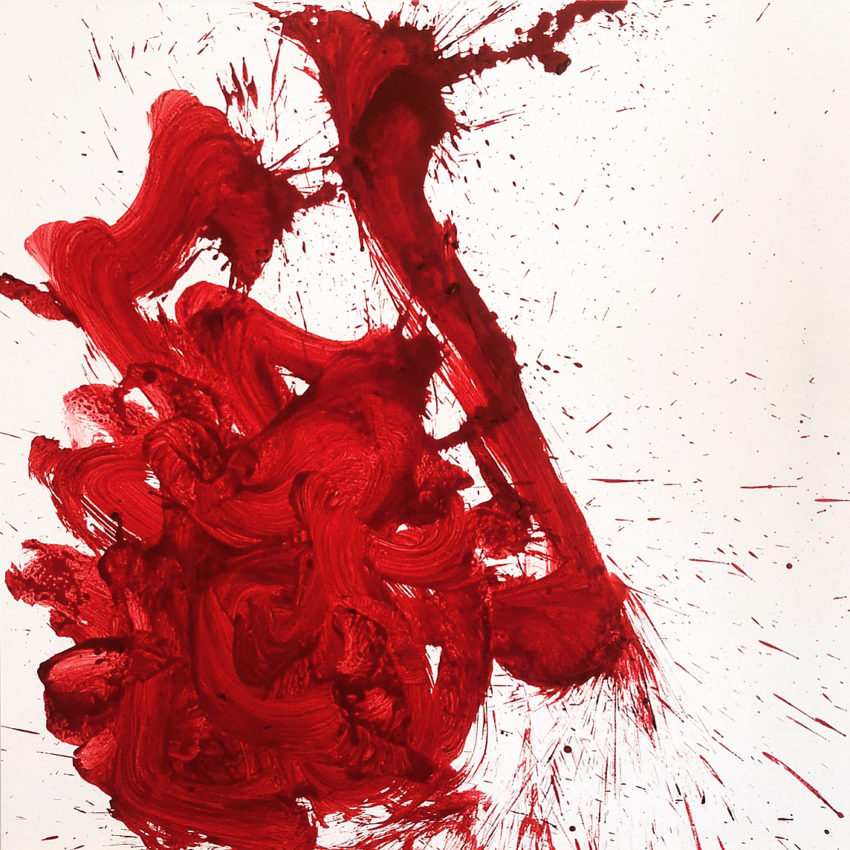
Reuse
By employing different discarded materials, this series asks society: “What is value?”
This series converts trash that is economically worthless into artwork. It pushes the boundaries of painting to create a unique visual impression that aims to change the perception of the audience. In society, everything has a price, but it often fluctuates. It does not necessarily reflect society’s needs and demands, nor does it reflect measurable functionality.
Today, even art has become a commodity — an investment in future gains with the expectation of an increase in price. However, nobody can define what art is truly valuable as nobody can define the true value of art.
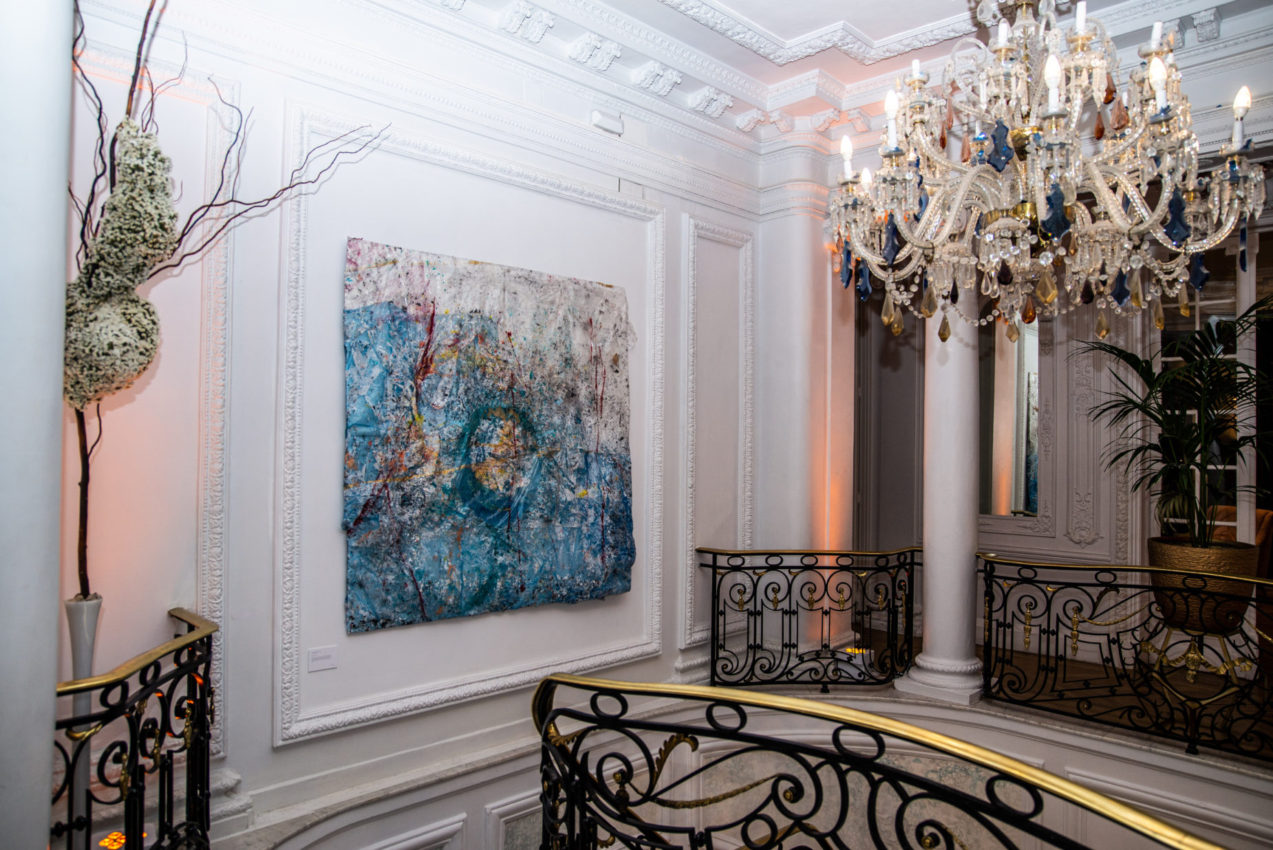
What is our consciousness? How has it been made? Can we be aware of everything in our minds?
What we are aware of is just a little part of ourselves. We create ourselves without realizing what we create ourselves.
A Dialogue With Nature
From the COVID-19 pandemic, wildfires in Australia, and Typhoon Haishen to extreme heat in California, flooding in Jakarta, and the earthquake in Alaska, 2020 has been a year filled with natural disasters. We have been forced to re-think our relationship with nature and realize how vulnerable we are when confronted by Mother Nature. Though we have technology that allows us to live in such a comfortable and safe world, these natural disasters have shown us that humans have been overconfident in themselves. It is time for us to change the way we think about nature, from “how to control nature” to “how to live with nature.” For a long time, humans have thought that we are superior to other animals and living beings. Human-developed technology has led us to think that we are in a position to control nature. Just as it is important to listen to others in order to understand them better and develop better relationships, it is necessary to listen to what nature tells us. It is time for us to have a dialogue with nature.
This artwork consists of two colors: red and white, which represent the artist’s origin: Japan. Throughout Japan’s history, the fundamental philosophy of life has always been to “live with nature.” While the Western world’s focus has been on dominating nature, including the domestication of animals and overcoming natural limitations such as gravity, the Japanese approach has been co-living with nature. As it is globally known, Japan has had to deal with many kinds of natural disasters: typhoons, earthquakes, volcanoes, and tsunamis. So, Japan has cultivated a way of thinking about how to co-exist with nature, rather than controlling it. Therefore, the principal colors of the artwork represent the importance of communication with nature, rather than controlling nature. It is important to emphasize that this has nothing to do with nationalism, but is about bringing an Eastern philosophy on nature to the Western world in order to change the way we deal with nature.
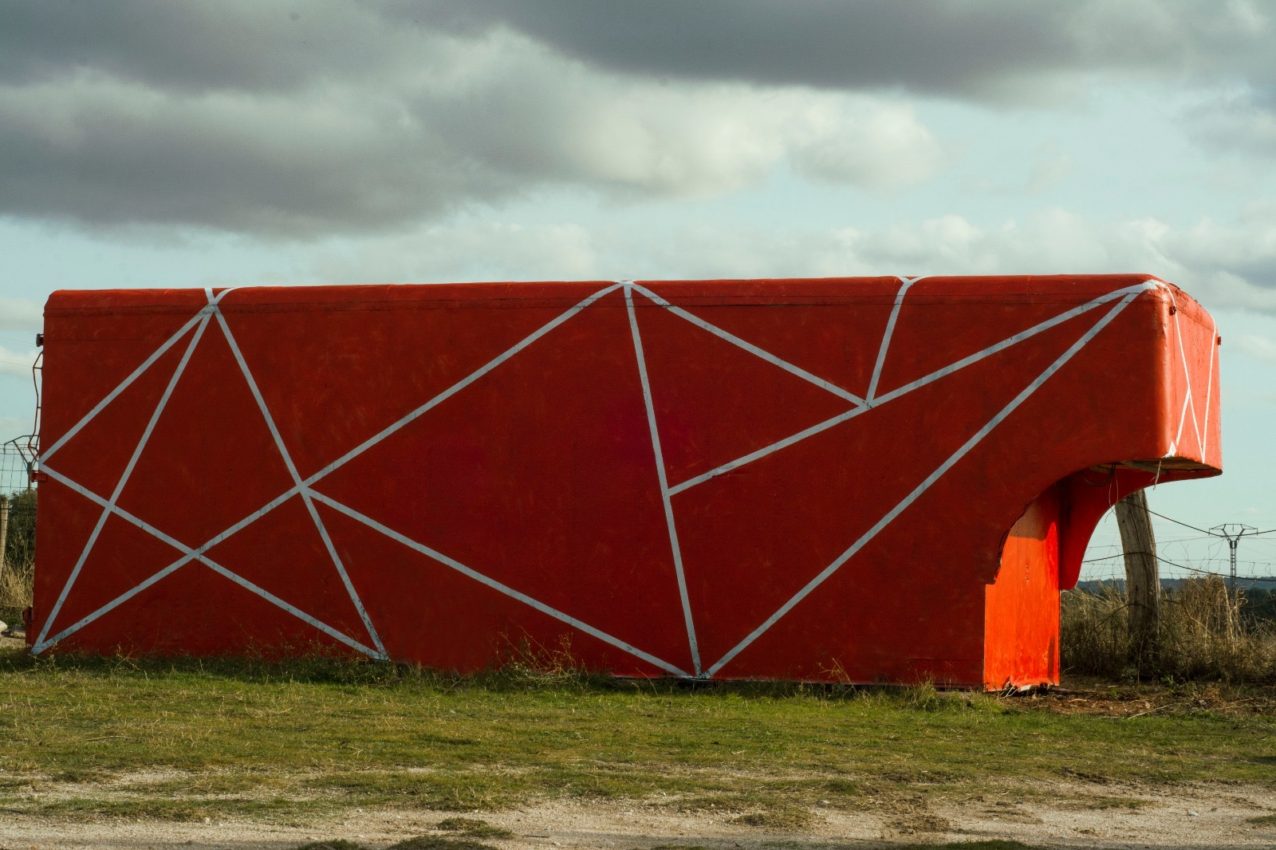
From a contemporary art perspective, the value of this artwork is embedded in the context and environment of its creation. By placing the artwork in the middle of nowhere, far away from a city center, it creates a clear and strong contrast between nature and human development. By using a ready-made object—a container that has enabled humans to accelerate the transportation of goods such as livestock and commercial products—it raises a hairy question: “Is art truly meaningful or merely a manifestation of the human ego?” There is a premise in the art world that art is meaningful and valuable for humanity. However, if we change the perspective from human-centered to nature-centered, it is obvious that humans are just a small part of nature. So, there is a radical and fundamental question of whether human creation is truly meaningful and valuable to nature. For the audience, this artwork is a means to deliver a message to change the way we engage with nature. However, from the perspective of a practicing contemporary artist, this artwork serves to challenge the basic premise and consensus of art itself and generate a disruptive shift in the way we think about ourselves.
Public Artworks
Artwork is made as a catalyst to connect spaces with the universe. It serves as a door to an unknown reality and makes the invisible visible.
This series aims to produce catalysts to connect people beyond borders such as nationality, language, generation, religion, and gender. Its prime purpose is the exploration of ways in which art can contribute to global society and partially solve global issues and problems, rather than focusing on its economic value and role in the marketplace.
This series challenges the idea that artworks are merely tradable merchandise and posits that its pure purpose can be of service to society.
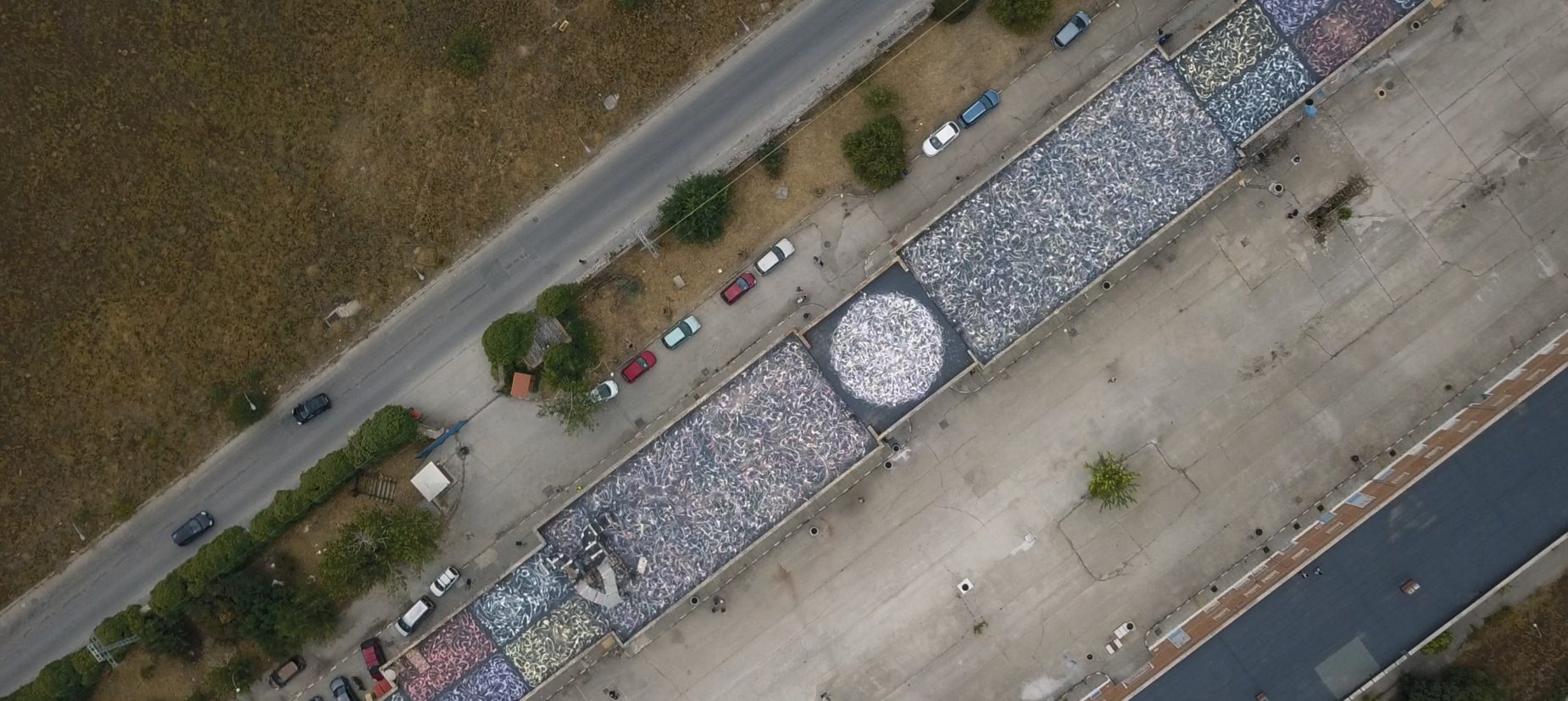
This artwork is the biggest calligraphic artwork in Europe (1926 sq meters) and was created on the rooftop of the Zapadores Museum.
The artwork represents the transition from the chaotic and unorganized world to the organized but united world where people can respect others having different cultures and backgrounds.
The enormous size represents how it is important to open your mind and accept others to connect us beyond borders and realize a truly peaceful world.
