Biography · b. 1987

About the Artist

Masaaki Hasegawa (1987) is a multidisciplinary artist and author based in Spain. His practice investigates painting as a process of embodied perception shaped by temporality, material transformation, and sensory experience.

Working through abstraction and ritualized gesture, he explores how shifting psychological, bodily, and environmental conditions become embedded within physical action and material surfaces. Flowers occupy a central role — functioning simultaneously as tools, perceptual interfaces, and material agents that alter bodily movement, pressure, rhythm, and sensory feedback within the act of painting.

Influenced by long-term engagement with martial arts, underground culture, analytical disciplines, and collaborations with scientific and technical fields, his work operates between painting, performance, and perceptual inquiry.

Hasegawa has realized large-scale projects and exhibited internationally across Europe, the Middle East, and Asia, including a 1,926-square-meter site-specific work in Madrid.
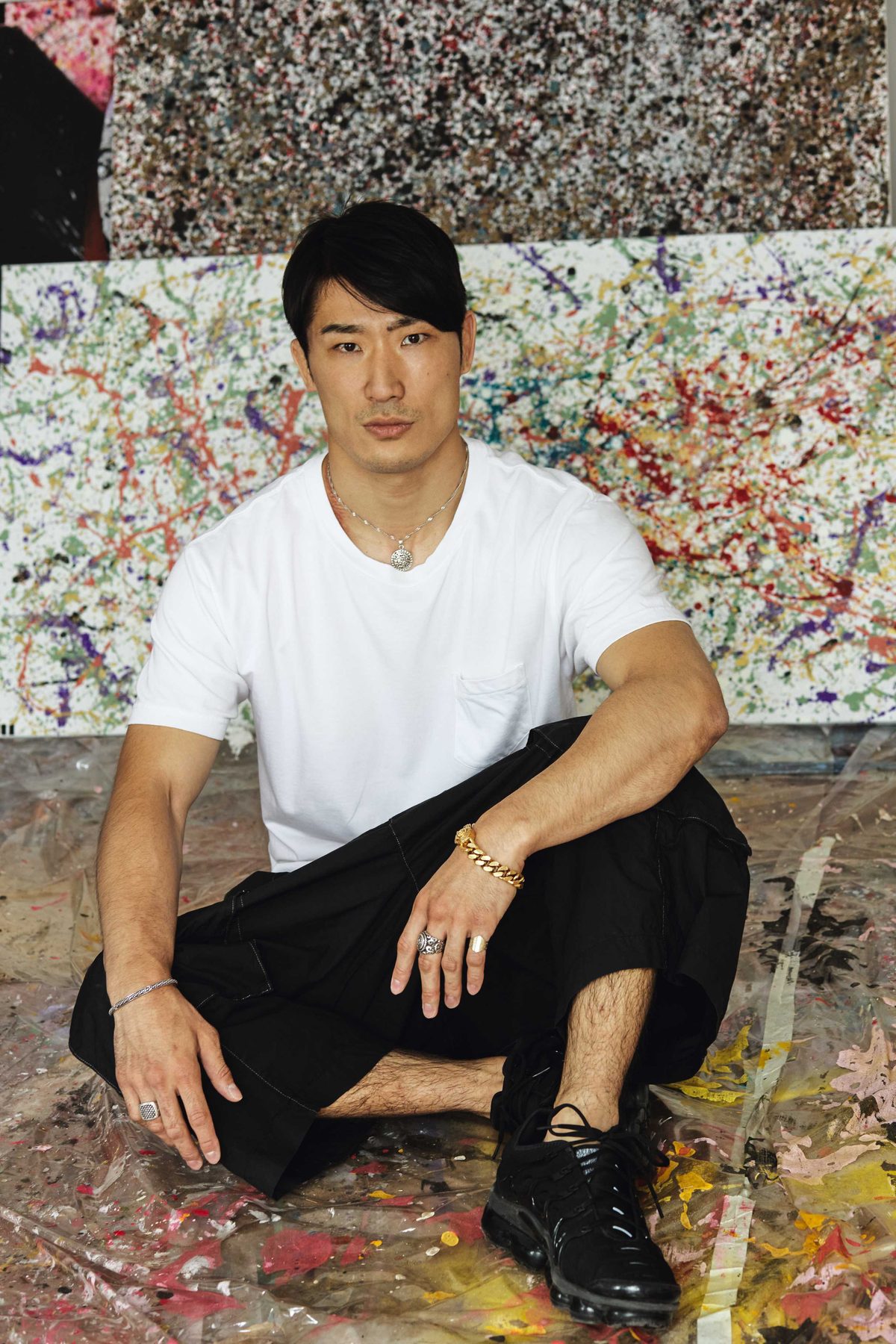
Work by Masaaki Hasegawa
From the studio — abstraction through ritualized gesture.
Artist Statement

A temporary field of negotiation.

My practice approaches painting as an embodied and ritualized process through which perception, bodily awareness, movement, and material transformation continuously interact. Rather than beginning from predetermined images, the work emerges through fluctuating psychological, sensory, and environmental conditions experienced in real time.

I am interested in how transient internal states — tension, obsession, instability, concentration, absence, exhaustion, or sensory overload — become physically embedded within gesture, repetition, and material surfaces. Painting functions not as representation, but as a temporal condition in which cognition, bodily action, and material behavior briefly converge.

I do not approach painting as the production of autonomous images, but as the residual trace of an event — a temporary convergence between body, cognition, sensation, environment, and material process. Impermanence is therefore not treated as a theme alone, but as a structural condition underlying perception, memory, and existence itself.

Selected Exhibitions

Solo Exhibitions

Feb 2018Tokyo CamiiTokyo
Jul 2018Kyiv Academy of Media ArtsKyiv
Jun 2019Kharkiv State Academy of Design and ArtsKharkiv
Dec 2019Alma SensaiMadrid
Jan 2020Red Cross MadridMadrid
Feb 2020Hotel EurostarsMadrid
Mar 2020Palacio de los Barrantes-CervantesTrujillo
Jul 2020Molotow HeadquarterLahr
Sep 2021O_lumenMadrid
Nov 2021IE Business SchoolMadrid
Apr 2022White LabMadrid
Oct 2022Japan WeekendMadrid
Jan 2023HN34 GalleryMadrid
May 2023CÓMPLICESMadrid
Jan 2024SUUSMadrid
Feb 2024María Porto GalleryMadrid
2024Club Prim 5Madrid
Nov 2024Centro Joaquín Roncal — Fundación CAIZaragoza
2025Espacio JovellanosMadrid
2025Lapislazuli GalleryMadrid
Oct 2025Aldama Fabre GalleryBilbao
Feb 2026Pelayo50 GalleryMadrid
Apr 2026Tierra Y TiempoMadrid

Group Exhibitions

Mar 2017Galerie PerahiaParis
Apr 2017Orellana 5Madrid
Sep 2017Contemporary Museum of CalligraphyMoscow
Oct 2017BECURIOUS GalleryMadrid
Dec 2017LetstalkaboutArtMadrid
Feb 2018Galerie PerahiaParis
Feb 2018Urvanity ArtMadrid
May 2018C.A.L.L.EMadrid
May 2018Galerie WalllworksParis
Sep 2018AkTKyiv
Sep 2018Zapadores MuseumMadrid
Jun 2020C.A.L.L.EMadrid
Apr 2021Madrid Fashion WeekMadrid
Sep 2021Madrid Fashion WeekMadrid
Mar 2022Madrid Fashion WeekMadrid
2026Dolores PromesaMadrid

Collections